AI in Management Education: Opportunities, Risks, and Future Research Directions
AI in Management Education: Opportunities, Risks, and Future Research Directions
Introduction
Artificial Intelligence (AI) has rapidly evolved from an emerging technology into a transformative force across industries. From finance and healthcare to manufacturing and public administration, AI is reshaping how organizations operate, make decisions, and create value. Higher education, particularly management education, is experiencing a similar transformation.
Business schools and management institutions are increasingly integrating AI into teaching, research, curriculum development, administrative processes, and student engagement. Tools powered by machine learning, generative AI, predictive analytics, and intelligent automation are changing how future managers acquire knowledge and develop professional competencies.
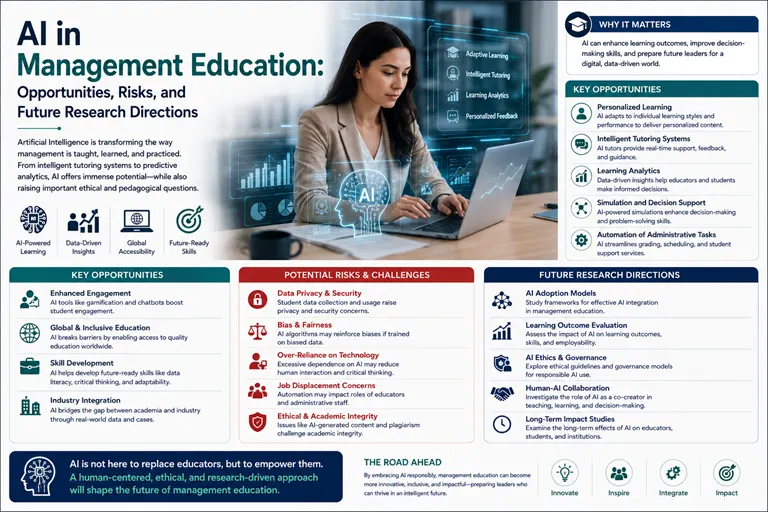
As organizations adopt AI-driven business models, graduates entering the workforce are expected to understand not only management theories but also the strategic use of AI in decision-making, innovation, leadership, and organizational transformation.
While AI offers tremendous opportunities for improving educational quality and accessibility, it also introduces ethical, academic, and governance challenges. Issues related to academic integrity, data privacy, algorithmic bias, overdependence on AI, and digital inequality require thoughtful consideration by educators and institutions.
This article examines the growing role of AI in management education, explores its benefits and risks, and highlights future research opportunities for scholars, educators, and policy makers.
The Growing Role of AI in Management Education
Management education has traditionally focused on leadership, organizational behavior, finance, marketing, strategy, entrepreneurship, operations, and human resource management. Today, AI is becoming an essential component across these disciplines.
Business schools increasingly use AI to:
- Personalize learning experiences
- Automate administrative tasks
- Support case study analysis
- Improve assessment methods
- Enhance student engagement
- Deliver intelligent tutoring
- Analyze learning outcomes
- Support academic research
Rather than replacing educators, AI is increasingly viewed as a tool that complements teaching while enabling more data-driven and student-centered learning.
Key Opportunities of AI in Management Education
Personalized Learning
One of AI's greatest advantages is its ability to tailor educational experiences to individual learning needs.
AI-powered systems can:
- Recommend learning materials
- Identify knowledge gaps
- Adapt course difficulty
- Provide personalized feedback
- Suggest additional practice resources
Personalized learning improves student engagement and supports continuous skill development.
Intelligent Tutoring Systems
AI-based tutoring platforms provide students with immediate support outside traditional classroom hours.
Benefits include:
- Instant responses to academic queries
- Interactive learning experiences
- Continuous availability
- Individualized guidance
- Enhanced conceptual understanding
These systems supplement faculty instruction while improving accessibility.
Data-Driven Decision Making
Management education increasingly emphasizes analytical thinking.
AI enables students to work with:
- Predictive analytics
- Business intelligence
- Market forecasting
- Financial modeling
- Consumer behavior analysis
- Operational optimization
Exposure to AI-supported decision-making better prepares graduates for modern organizations.
Enhanced Research Capabilities
Researchers benefit from AI through:
- Literature discovery
- Data analysis
- Pattern recognition
- Qualitative coding
- Bibliometric analysis
- Predictive modeling
These capabilities accelerate research while supporting interdisciplinary collaboration.
Administrative Efficiency
Educational institutions increasingly apply AI to streamline routine administrative processes.
Applications include:
- Student admissions
- Timetable scheduling
- Academic advising
- Resource allocation
- Student support services
- Performance monitoring
Automation allows educators to dedicate more time to teaching and mentoring.
AI Across Management Disciplines
Artificial Intelligence influences virtually every area of management education.
Marketing
- Consumer analytics
- Personalized marketing
- Customer segmentation
- Digital advertising
Finance
- Fraud detection
- Credit risk analysis
- Algorithmic trading
- Financial forecasting
Human Resource Management
- Recruitment analytics
- Workforce planning
- Employee engagement analysis
- Talent management
Operations Management
- Supply chain optimization
- Inventory forecasting
- Process automation
- Predictive maintenance
Strategic Management
- Competitive intelligence
- Scenario planning
- Business forecasting
- Decision support systems
Integrating AI across these disciplines helps students understand technology's strategic role in modern organizations.
Challenges and Risks
Despite its advantages, AI adoption presents several important challenges.
Academic Integrity
Generative AI tools can produce essays, reports, and business analyses with minimal human effort.
Institutions must develop clear policies regarding responsible AI use while maintaining academic honesty.
Overdependence on AI
Students should develop critical thinking rather than relying exclusively on automated recommendations.
Management education should encourage balanced use of AI alongside independent analysis.
Data Privacy
AI systems frequently process large volumes of student data.
Institutions must ensure compliance with data protection regulations while maintaining transparency and security.
Algorithmic Bias
AI systems learn from historical data, which may contain biases.
Educators should teach students to evaluate AI outputs critically and understand the ethical implications of automated decision-making.
Digital Divide
Not all students have equal access to advanced technologies.
Educational institutions should promote equitable access to digital learning resources.
Ethical Considerations
Responsible AI adoption requires strong ethical governance.
Business schools should encourage students to examine:
- Transparency
- Accountability
- Fairness
- Privacy
- Human oversight
- Responsible innovation
- Social responsibility
- Sustainability
Future managers must understand that AI decisions can have significant organizational and societal consequences.
AI and Faculty Development
Successful AI integration depends not only on technology but also on faculty readiness.
Institutions should invest in:
- Faculty training
- Digital pedagogy
- AI literacy
- Curriculum redesign
- Interdisciplinary collaboration
- Continuous professional development
Empowering educators ensures that AI enhances rather than replaces quality teaching.
AI and Sustainable Management Education
AI supports sustainable management education by enabling evidence-based decision-making and responsible resource utilization.
Applications include:
- ESG analytics
- Carbon footprint analysis
- Sustainable supply chain management
- Circular economy modeling
- Climate risk assessment
- Resource optimization
Students equipped with AI competencies are better prepared to address sustainability challenges facing modern organizations.
Emerging Trends in 2026
Several developments continue shaping AI in management education.
These include:
- Generative AI-assisted learning
- AI-powered virtual classrooms
- Adaptive learning platforms
- Learning analytics
- Intelligent assessment systems
- AI-supported business simulations
- Virtual internships
- Personalized career guidance
- Digital credentialing
- AI-enhanced collaborative learning
These innovations continue transforming business education worldwide.
Future Research Directions
Researchers have numerous opportunities to investigate AI's impact on management education.
Potential topics include:
- AI adoption in business schools
- Faculty readiness for AI integration
- Student acceptance of AI tools
- AI ethics in higher education
- Learning analytics
- Personalized education models
- AI-assisted assessment
- Digital transformation of universities
- AI and leadership development
- Sustainable AI education
- AI-supported entrepreneurship education
- Human-AI collaboration in learning
These research areas offer valuable contributions to management scholarship.
Implications for Educational Institutions
Educational institutions should view AI as a strategic resource rather than simply another educational technology.
Successful implementation requires:
- Institutional leadership
- Ethical governance
- Faculty development
- Curriculum innovation
- Student digital literacy
- Continuous evaluation
- Responsible technology adoption
Business schools that effectively integrate AI into management education will better prepare graduates for increasingly technology-driven workplaces.
Frequently Asked Questions
What is AI in management education?
AI in management education refers to the application of artificial intelligence technologies to improve teaching, learning, research, assessment, administration, and decision-making in business and management programs.
How does AI benefit business schools?
AI enhances personalized learning, research capabilities, administrative efficiency, learning analytics, and data-driven decision-making while improving student engagement.
What are the major risks of AI in education?
Key challenges include academic integrity, algorithmic bias, data privacy, digital inequality, overdependence on technology, and ethical governance.
Will AI replace management educators?
No. AI is expected to support educators by automating routine tasks and enhancing learning experiences rather than replacing faculty expertise and mentorship.
What research opportunities exist in AI and management education?
Researchers can investigate AI adoption, ethics, learning analytics, digital transformation, faculty readiness, personalized learning, sustainable education, and AI-supported leadership development.
Conclusion
Artificial Intelligence is reshaping management education by creating new opportunities for personalized learning, research innovation, data-driven decision-making, and institutional efficiency. At the same time, its growing adoption requires thoughtful attention to ethics, academic integrity, digital inclusion, and responsible governance.
As business schools prepare future leaders for AI-enabled organizations, educators must balance technological innovation with critical thinking, ethical leadership, and human-centered management principles. Institutions that embrace responsible AI integration will be better positioned to deliver high-quality education while preparing graduates for the evolving demands of the global economy.
The International Journal of Management and Sustainability Practices (IJMSP) welcomes high-quality research on Artificial Intelligence, management education, digital transformation, educational innovation, organizational learning, sustainable management, business analytics, and related interdisciplinary topics. Scholarly contributions in these areas will play an essential role in shaping the future of management education.