Authentic Leadership and Employee Trust: A Management Perspective for Modern Organizations
Authentic Leadership and Employee Trust: A Management Perspective for Modern Organizations
Introduction
Leadership has always been a defining factor in organizational success. However, in today's rapidly evolving business environment, employees expect more than technical expertise and strategic decision-making from their leaders. They seek transparency, integrity, fairness, empathy, and consistency. These expectations have made authentic leadership one of the most influential leadership approaches in modern management research.
Organizations that cultivate authentic leadership often experience stronger employee trust, improved collaboration, higher engagement, and greater organizational resilience. As businesses continue adapting to digital transformation, hybrid work environments, artificial intelligence, and global competition, leadership built on trust and ethical behavior has become increasingly important.
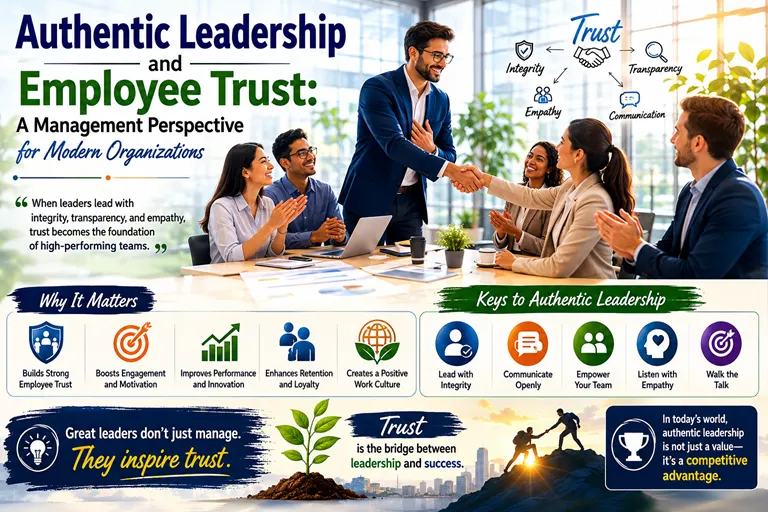
This article explores the concept of authentic leadership, its relationship with employee trust, organizational outcomes, implementation strategies, current research trends, and future opportunities for management scholars and practitioners.
Understanding Authentic Leadership
Authentic leadership is a leadership style characterized by genuine behavior, ethical decision-making, self-awareness, relational transparency, and consistency between personal values and organizational actions.
Unlike leadership approaches based primarily on authority or control, authentic leaders inspire confidence by acting honestly and demonstrating accountability in their interactions with employees and stakeholders.
Authentic leaders focus on long-term organizational success while maintaining ethical standards and supporting employee growth.
The Four Pillars of Authentic Leadership
Management scholars commonly describe authentic leadership through four interconnected dimensions.
Self-Awareness
Authentic leaders understand their strengths, limitations, emotions, and personal values. This awareness enables them to make balanced decisions while continuously improving their leadership capabilities.
Relational Transparency
Transparency encourages open communication and honest relationships. Authentic leaders openly share information, acknowledge challenges, and create an environment where employees feel comfortable expressing their opinions.
Balanced Decision-Making
Rather than relying solely on personal opinions, authentic leaders evaluate multiple perspectives before making decisions. They encourage constructive discussions and evidence-based problem-solving.
Internalized Moral Perspective
Ethical values guide authentic leaders even when facing difficult organizational situations. Their decisions are driven by integrity instead of short-term personal or organizational gains.
Why Employee Trust Matters
Trust forms the foundation of productive workplace relationships.
Employees who trust their leaders are more likely to:
- Share innovative ideas
- Collaborate effectively
- Accept organizational change
- Demonstrate organizational commitment
- Remain loyal during challenging periods
- Support strategic initiatives
- Maintain higher motivation
Conversely, low trust often results in poor communication, increased turnover, workplace conflict, and reduced organizational performance.
How Authentic Leadership Builds Employee Trust
Honest Communication
Transparent communication reduces uncertainty and strengthens confidence in leadership decisions.
Consistency Between Words and Actions
Employees closely observe whether leaders follow the standards they promote. Consistent behavior reinforces credibility.
Ethical Decision-Making
Fair treatment and unbiased decision-making create a sense of justice, encouraging employees to trust organizational leadership.
Respect for Employees
Authentic leaders value employee contributions, actively listen to concerns, and promote inclusive decision-making.
Accountability
Leaders who acknowledge mistakes and take responsibility demonstrate integrity, strengthening long-term trust.
Organizational Benefits of Authentic Leadership
Organizations that promote authentic leadership often experience multiple positive outcomes.
Higher Employee Engagement
Employees who trust leadership tend to demonstrate stronger emotional commitment to organizational goals.
Improved Organizational Commitment
Authentic leadership encourages loyalty by creating supportive and respectful work environments.
Better Team Collaboration
Open communication promotes knowledge sharing, innovation, and teamwork.
Reduced Employee Turnover
Employees are generally more likely to remain in organizations where leadership demonstrates fairness and transparency.
Increased Innovation
Trust encourages employees to share new ideas without fear of criticism, supporting organizational creativity and continuous improvement.
Stronger Organizational Reputation
Organizations recognized for ethical leadership often enjoy enhanced employer branding, customer confidence, and stakeholder trust.
Authentic Leadership in Hybrid and Digital Workplaces
The expansion of remote and hybrid work has transformed leadership responsibilities.
Authentic leaders now need to build trust despite reduced face-to-face interaction.
Effective strategies include:
- Frequent communication
- Virtual transparency
- Regular feedback sessions
- Digital collaboration tools
- Recognition of employee contributions
- Support for work-life balance
- Inclusive virtual meetings
Technology supports communication, but authentic leadership remains essential for maintaining meaningful workplace relationships.
Challenges in Practicing Authentic Leadership
Despite its advantages, implementing authentic leadership presents several challenges.
Organizational Pressure
Leaders often face conflicting expectations from shareholders, customers, regulators, and employees.
Rapid Decision-Making
Business environments sometimes require immediate decisions, limiting opportunities for collaborative consultation.
Cultural Differences
Leadership expectations vary across countries and organizational cultures, requiring adaptive leadership approaches.
Resistance to Transparency
Some organizational cultures continue to favor hierarchical communication, making openness difficult.
Leadership Development
Developing authentic leadership requires continuous reflection, coaching, mentoring, and organizational support.
Strategies for Developing Authentic Leaders
Organizations can strengthen authentic leadership through structured development initiatives.
Recommended practices include:
- Leadership coaching
- Ethical leadership training
- Emotional intelligence development
- Mentoring programs
- Reflective learning
- 360-degree feedback
- Transparent performance evaluation
- Inclusive organizational culture
- Diversity and inclusion initiatives
- Continuous professional development
Leadership development should focus not only on technical competencies but also on personal values and ethical responsibility.
Authentic Leadership and Organizational Sustainability
Responsible leadership contributes directly to organizational sustainability.
Authentic leaders promote:
- Ethical governance
- Employee well-being
- Corporate social responsibility
- Stakeholder engagement
- Responsible innovation
- Long-term strategic planning
These principles align with the growing emphasis on sustainable management practices in modern organizations.
Emerging Research Trends
Management researchers continue exploring new dimensions of authentic leadership.
Current areas of interest include:
- Authentic leadership and artificial intelligence
- Leadership in virtual organizations
- Employee psychological safety
- ESG leadership
- Sustainable organizational performance
- Digital transformation and leadership
- Employee resilience
- Workplace diversity and inclusion
- Ethical decision-making under uncertainty
- Leadership during organizational crises
These topics provide valuable opportunities for interdisciplinary management research.
Implications for Researchers and Practitioners
For researchers, authentic leadership remains an evolving field with applications across organizational behavior, human resource management, strategic management, and sustainability studies.
For practitioners, investing in leadership authenticity strengthens organizational trust, employee commitment, innovation, and long-term competitiveness.
Organizations that cultivate authentic leadership are often better equipped to navigate uncertainty while maintaining ethical standards and stakeholder confidence.
Frequently Asked Questions
What is authentic leadership?
Authentic leadership is a leadership approach based on self-awareness, ethical behavior, transparency, and consistency between personal values and professional actions.
Why is employee trust important?
Employee trust improves collaboration, engagement, organizational commitment, innovation, and overall workplace performance.
How does authentic leadership improve organizational performance?
Authentic leadership strengthens communication, reduces employee turnover, enhances teamwork, increases engagement, and promotes ethical decision-making.
Can authentic leadership be developed?
Yes. Through leadership training, mentoring, coaching, emotional intelligence development, and continuous self-reflection, leaders can strengthen authentic leadership competencies.
Is authentic leadership suitable for hybrid workplaces?
Yes. Authentic leadership is particularly valuable in hybrid and remote work environments because transparency, communication, and trust become even more important when employees work across different locations.
Conclusion
Authentic leadership is more than a contemporary management concept; it is a strategic capability that enables organizations to build lasting trust, strengthen employee engagement, and achieve sustainable performance. In an era defined by digital transformation, evolving workforce expectations, and increasing emphasis on ethical governance, leaders who demonstrate integrity, transparency, and accountability are better positioned to guide their organizations through change.
The International Journal of Management and Sustainability Practices (IJMSP) encourages researchers, practitioners, and academicians to contribute original research exploring authentic leadership, organizational behavior, employee engagement, responsible management, workplace culture, and sustainable leadership practices. Advancing evidence-based leadership research will continue to shape resilient and responsible organizations for the future.