
How to Get ISSN and Crossref DOI for a New Academic Journal
How to Get ISSN and Crossref DOI for a New Academic Journal: A Practical Guide for Editors and Publishers
Introduction
Launching an academic journal is an important milestone for universities, research institutions, scholarly societies, and independent publishers. However, establishing a credible journal requires more than publishing research articles. Two essential components that significantly enhance a journal's visibility and credibility are an International Standard Serial Number (ISSN) and Crossref Digital Object Identifiers (DOIs).
An ISSN uniquely identifies your journal as a serial publication, while Crossref DOIs provide permanent identifiers for individual scholarly articles, making them easier to discover, cite, and access. Although these processes are related, they serve different purposes and should be planned carefully from the beginning of your journal's development.
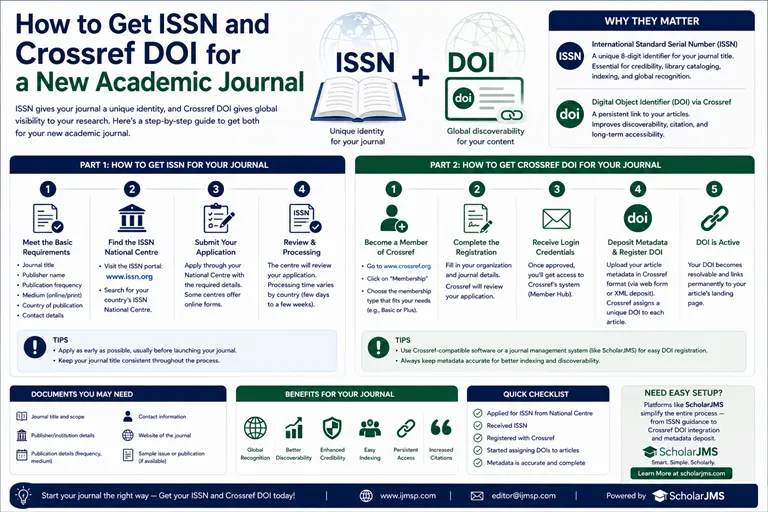
This guide explains how to obtain an ISSN, prepare for Crossref DOI registration, avoid common mistakes, and build a journal that is ready for long-term scholarly publishing.
Understanding the Difference Between ISSN and DOI
Many new publishers confuse ISSN and DOI, but they serve distinct roles.
ISSN
An ISSN is an eight-digit international identifier assigned to serial publications such as academic journals. It identifies the journal itself rather than individual articles. Requests are handled through the appropriate national ISSN centre or the ISSN International Centre.
Crossref DOI
A Digital Object Identifier (DOI) is assigned to individual research outputs, such as journal articles. Through Crossref, publishers register DOIs together with rich metadata, creating persistent links and improving discoverability. Crossref members receive a DOI prefix and are responsible for registering and maintaining article metadata.
Why Every New Journal Needs an ISSN
An ISSN is more than a number displayed on a journal website.
It helps:
- Identify your journal internationally.
- Differentiate journals with similar titles.
- Support library cataloguing.
- Improve discoverability.
- Strengthen publishing credibility.
- Support future indexing applications.
Many indexing services and scholarly databases expect journals to have a valid ISSN before evaluation.
When Should You Apply for an ISSN?
Many editors ask whether they should apply for an ISSN before or after launching their journal.
The best approach is to apply after your journal website is professionally prepared but before regular publication begins.
Your journal should already have:
- Journal title
- Clearly defined aims and scope
- Editorial board
- Publication ethics
- Peer review policy
- Author guidelines
- Contact information
- Publishing frequency
- Professional website
Preparing these elements first significantly improves readiness for the application process.
Step-by-Step Guide to Getting an ISSN
Step 1: Finalize Your Journal Identity
Determine:
- Journal title
- Scope
- Subject area
- Publication frequency
- Publisher details
- Website URL
Consistency is important because these details become part of your journal's official record.
Step 2: Build a Professional Journal Website
A journal website should include:
- Home
- About Journal
- Editorial Board
- Aims & Scope
- Author Guidelines
- Publication Ethics
- Peer Review Policy
- Current Issue
- Archives
- Contact Page
- Online Submission System
A professionally designed website demonstrates publication readiness.
Why ScholarJMS?
Many new publishers choose ScholarJMS because it provides:
- Journal website development
- Online manuscript submission
- Editorial workflow
- Peer review management
- Issue publication
- DOI-ready article pages
- Responsive design
- SEO-friendly architecture
Rather than assembling multiple systems, ScholarJMS offers an integrated publishing environment for modern academic journals.
Need Help Preparing Your Journal for ISSN?
Our publishing team can assist with:
- ScholarJMS journal website setup
- Journal launch consulting
- Editorial workflow configuration
- Website readiness assessment
- ISSN consulting
WhatsApp: +91 82003 85143
Email: inquiry@ojscloud.com
Why Crossref DOI Matters
A DOI is a permanent identifier assigned to individual scholarly works.
Benefits include:
- Permanent article URLs
- Improved citation accuracy
- Better discoverability
- Enhanced metadata quality
- Stronger scholarly visibility
- Compatibility with research databases
Crossref recommends registering DOI records with complete and consistent metadata for journal articles.
How to Get Crossref DOI
There are generally two approaches.
Option 1: Become a Direct Crossref Member
Organizations that publish scholarly content can apply for Crossref membership. Members receive a DOI prefix and are responsible for registering and maintaining DOI metadata.
Option 2: Use a Sponsored DOI Service
Many smaller publishers and newly established journals work with experienced service providers that assist with Crossref onboarding, metadata preparation, DOI registration, and workflow implementation.
For many new journals, this approach simplifies implementation while reducing technical complexity.
Planning Your DOI Workflow
Before assigning DOIs, prepare:
- Article titles
- Author names
- Abstracts
- Keywords
- ORCID identifiers (where available)
- Publication dates
- Volume and issue information
- Landing page URLs
Accurate metadata improves discoverability across scholarly systems.
Why GetDOI?
GetDOI helps journals with:
- Crossref onboarding guidance
- DOI workflow planning
- Metadata preparation
- Registration assistance
- Best publishing practices
Whether your journal is new or already publishing, proper DOI planning helps establish a reliable scholarly publishing workflow.
Need Help with Crossref DOI Registration?
We provide complete support for:
- Crossref DOI setup
- Metadata preparation
- DOI workflow implementation
- ScholarJMS integration
- Publishing consultation
WhatsApp: +91 82003 85143
Email: inquiry@ojscloud.com
Common Mistakes New Publishers Should Avoid
Many new journals encounter unnecessary delays because of avoidable mistakes.
Common issues include:
- Applying for an ISSN before the website is complete.
- Missing publication ethics or peer review policies.
- Incomplete editorial board information.
- Poor metadata preparation.
- Delaying DOI planning until after publication.
- Publishing without a structured editorial workflow.
- Inconsistent journal branding.
- Weak website navigation.
Careful planning significantly reduces these challenges.
ISSN, DOI, and Editorial Workflow
Obtaining an ISSN and assigning DOIs should not be treated as isolated tasks.
They work best when integrated into a complete publishing workflow that includes:
- Manuscript submission
- Editorial screening
- Peer review
- Copyediting
- Proofreading
- DOI assignment
- Online publication
- Metadata maintenance
- Long-term archiving
A modern journal management system simplifies this process and helps maintain consistency throughout the publication lifecycle.
Why Planning Early Saves Time
Editors often postpone ISSN and DOI planning until the first issue is almost ready.
However, early preparation offers several advantages:
- Better website structure
- Cleaner metadata
- Faster publication workflows
- Reduced administrative corrections
- Improved discoverability
- Greater confidence for authors and reviewers
Strategic planning supports sustainable journal growth.
Frequently Asked Questions
What is the difference between an ISSN and a DOI?
An ISSN identifies the journal as a serial publication, while a DOI identifies an individual article or other scholarly work.
Can I get a DOI without an ISSN?
While DOI registration is managed through Crossref membership or sponsored services, journals typically establish their publication identity with an ISSN as part of professional publishing practice, and consistent journal metadata is expected.
Does every article need its own DOI?
Yes. Each published article should receive its own DOI so that it has a permanent and unique identifier.
Should I plan DOI registration before publishing?
Yes. Planning DOI workflows before publishing helps ensure accurate metadata and efficient publication processes.
Can professional consultants help with ISSN and DOI?
Yes. Many publishers seek expert assistance to prepare journal websites, organize metadata, streamline ISSN applications, and implement Crossref DOI workflows efficiently.
Conclusion
Obtaining an ISSN and implementing Crossref DOIs are two of the most important steps in establishing a credible academic journal. While the processes may appear straightforward, successful implementation depends on careful preparation, a professional journal website, accurate metadata, transparent editorial policies, and a well-organized publishing workflow.
By planning these elements from the beginning, publishers can improve discoverability, strengthen author confidence, and build a solid foundation for future indexing and scholarly recognition.
Ready to Launch Your Journal?
We provide complete publishing solutions for new and existing journals:
- ScholarJMS – Professional journal websites, manuscript submission, editorial workflow, and publishing management.
- OJSCloud – OJS hosting, migration, ISSN consulting, journal launch support, and publishing consultancy.
- GetDOI – Crossref DOI guidance, metadata preparation, and DOI workflow implementation.
- Scholar9 – Transparent peer review and research trust ecosystem.
Contact Us
WhatsApp: +91 82003 85143
Email: inquiry@ojscloud.com
Whether you are launching your first journal or modernizing an existing publication, we can help you establish a professional, standards-based scholarly publishing workflow.