How to Migrate an OJS Journal to a Modern Journal Management Platform
How to Migrate an OJS Journal to a Modern Journal Management Platform: A Complete Guide for Editors and Publishers
Introduction
Open Journal Systems (OJS) has been one of the most widely used open-source journal management platforms for academic publishing. Thousands of universities, scholarly societies, and independent publishers have successfully used OJS to manage manuscript submissions, peer review, and online publishing.
However, as scholarly publishing continues to evolve, many journals are reassessing whether their existing publishing infrastructure meets current expectations. Editors increasingly seek platforms that provide streamlined editorial workflows, improved author experiences, enhanced security, mobile-friendly interfaces, better search engine visibility, and reduced technical maintenance.
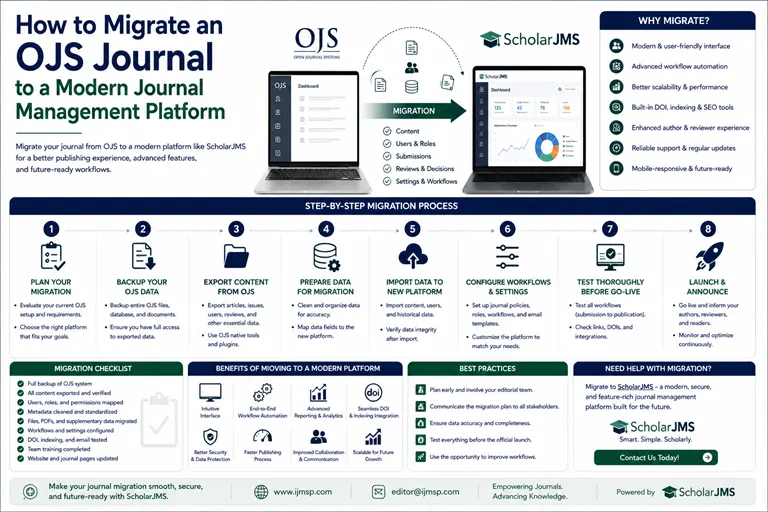
Migrating from OJS does not mean abandoning years of scholarly work. When planned correctly, migration allows journals to preserve published articles, metadata, DOIs, archives, and search engine rankings while adopting a more modern publishing environment.
This guide explains when migration should be considered, what should be preserved, how to migrate safely, common mistakes to avoid, and how modern journal management platforms can support long-term publishing success.
Why Do Journals Consider Migrating from OJS?
Many journals continue to operate successfully on OJS. However, publishers sometimes decide to migrate because their operational needs have changed.
Common reasons include:
- Growing submission volume
- Increasing editorial workload
- Desire for workflow automation
- Modern website requirements
- Better author experience
- Mobile-responsive publishing
- Improved security
- Reduced technical maintenance
- Professional design
- Long-term scalability
Migration is generally driven by organizational growth rather than dissatisfaction alone.
Signs That Your Journal May Be Ready for Migration
Editors may consider migration if they experience:
- Manual editorial processes
- Slow workflow management
- Difficulty customizing the website
- Frequent technical maintenance
- Plugin compatibility issues
- Limited reporting capabilities
- Poor mobile usability
- Increasing IT support requirements
- Complex upgrades
- Expanding editorial teams
These challenges often become more noticeable as journals mature.
What Should Be Preserved During Migration?
A successful migration protects the journal's scholarly record.
Important elements include:
- Published articles
- Volume and issue archives
- PDF files
- HTML articles
- Author information
- Editorial board details
- Journal policies
- Metadata
- Keywords
- Abstracts
- DOI records
- URLs where appropriate
- Images and supplementary files
Protecting these assets ensures continuity for readers, authors, and indexing services.
Step 1: Assess Your Existing Journal
Before migration begins, perform a comprehensive audit.
Review:
- Current website
- Number of articles
- Issues published
- DOI records
- User accounts
- Editorial workflows
- Custom plugins
- Website structure
- Search engine performance
- Hosting environment
A detailed assessment reduces migration risks.
Step 2: Backup Everything
Never begin migration without complete backups.
Create secure copies of:
- Website files
- Database
- Uploaded documents
- Images
- PDFs
- DOI records
- Editorial correspondence
- User accounts
Reliable backups provide protection if unexpected issues occur.
Step 3: Choose the Right Platform
A migration is also an opportunity to evaluate future publishing needs.
A modern platform should support:
- Professional journal website
- Manuscript submission
- Editorial workflow
- Peer review
- Reviewer management
- Automated notifications
- DOI-ready publishing
- SEO optimization
- Mobile responsiveness
- Reporting dashboards
- Long-term scalability
Why ScholarJMS?
Many publishers migrating from OJS select ScholarJMS because it offers:
- Modern journal website development
- Integrated manuscript submission
- Editorial workflow automation
- Reviewer management
- Article publishing
- Archive management
- Responsive design
- SEO-friendly article pages
- Professional publishing support
ScholarJMS is designed to simplify editorial operations while allowing publishers to focus on research quality rather than software maintenance.
Planning an OJS Migration?
Our publishing specialists can help with:
- OJS to ScholarJMS migration
- Journal website redevelopment
- Editorial workflow optimization
- Data migration
- Publishing consultation
- Journal modernization
WhatsApp: +91 82003 85143
Email: inquiry@ojscloud.com
Step 4: Preserve DOI and Metadata
One of the most critical parts of migration is maintaining DOI integrity.
During migration:
- Preserve existing DOI records.
- Maintain article metadata.
- Verify DOI landing pages.
- Check article URLs.
- Validate Crossref registrations.
Careful DOI management prevents broken links and maintains citation continuity.
Step 5: Review ISSN Information
Migration does not normally require obtaining a new ISSN if the journal title and publishing format remain unchanged. However, publishers should verify that ISSN information is displayed consistently across the updated website and associated metadata.
Publishers planning major structural changes often benefit from professional guidance.
OJSCloud provides:
- ISSN consulting
- Website readiness review
- Publishing consultation
- Journal modernization support
Step 6: Improve Editorial Workflow
Migration should not simply replicate existing processes.
Instead, use the opportunity to improve:
- Submission management
- Reviewer assignment
- Editorial communication
- Automated reminders
- Decision tracking
- Production workflow
- Publication scheduling
Optimizing workflows increases editorial efficiency and author satisfaction.
Step 7: Test Before Launch
Before making the new website public, verify:
- Navigation
- Article pages
- PDF downloads
- DOI resolution
- Search functionality
- Submission forms
- User accounts
- Email notifications
- Mobile responsiveness
- Internal links
Comprehensive testing reduces post-launch issues.
Common Migration Mistakes
Editors should avoid:
- Migrating without backups
- Ignoring metadata quality
- Changing URLs unnecessarily
- Forgetting DOI verification
- Losing archived content
- Delaying testing
- Inadequate communication with stakeholders
- Overlooking SEO considerations
Proper planning minimizes these risks.
SEO Considerations During Migration
Website migration can affect search visibility if not managed carefully.
Important practices include:
- Preserving important URLs where possible
- Using redirects when URLs change
- Maintaining metadata
- Updating XML sitemaps
- Verifying search engine indexing
- Checking broken links
A well-planned migration helps maintain existing search rankings.
Benefits of Migrating to a Modern Platform
Organizations often experience improvements such as:
- Faster editorial workflows
- Better author experience
- Improved reviewer management
- Modern website design
- Reduced maintenance
- Better mobile performance
- Enhanced security
- Stronger SEO
- Improved scalability
- Easier administration
These benefits support sustainable journal growth.
Need Help Preserving DOI and ISSN During Migration?
Our team provides end-to-end migration assistance, including:
- OJS migration planning
- ScholarJMS implementation
- Crossref DOI verification
- ISSN consulting
- Website redevelopment
- Editorial workflow optimization
WhatsApp: +91 82003 85143
Email: inquiry@ojscloud.com
Why Many Publishers Choose OJSCloud
Migrating a journal involves technical, editorial, and publishing considerations.
OJSCloud supports publishers through:
- Migration planning
- Technical assistance
- Website redevelopment
- ISSN consulting
- Editorial workflow guidance
- Publishing best practices
Whether managing a single journal or multiple publications, structured migration support reduces risk and implementation time.
Frequently Asked Questions
Can an OJS journal be migrated without losing published articles?
Yes. With proper planning, published articles, PDFs, metadata, archives, and DOI records can be preserved during migration.
Will migration affect existing DOIs?
Existing DOIs can remain active if landing pages and metadata are properly managed and updated where required.
Should I change my journal website design during migration?
Migration provides an excellent opportunity to improve website usability, mobile responsiveness, accessibility, and SEO while preserving scholarly content.
Does migration require a new ISSN?
Generally, no. If the journal title and publication format remain unchanged, the existing ISSN usually continues to apply. Significant changes should be reviewed according to ISSN policies.
How long does journal migration usually take?
The timeline depends on the journal's size, complexity, number of published articles, customization requirements, and migration strategy.
Conclusion
Migrating an OJS journal is more than a technical project—it is an opportunity to modernize your entire publishing workflow. By carefully preserving published content, DOI records, metadata, editorial policies, and search visibility, journals can successfully transition to a platform that better supports long-term growth.
A modern journal management system enables editors to streamline submissions, enhance peer review, improve user experience, and reduce technical overhead while maintaining the integrity of the journal's scholarly record.
Ready to Modernize Your Journal?
We provide complete migration and publishing solutions, including:
- ScholarJMS – Modern journal websites, manuscript submission, editorial workflow, reviewer management, and online publishing.
- OJSCloud – OJS hosting, migration, ISSN consulting, journal launch support, and publishing consultancy.
- GetDOI – Crossref DOI guidance, metadata verification, DOI workflow support, and registration assistance.
- Scholar9 – Transparent peer review and research trust ecosystem.
Contact Our Publishing Experts
WhatsApp: +91 82003 85143
Email: inquiry@ojscloud.com
Whether you are migrating an established journal or planning a complete publishing modernization, our team can help you achieve a smooth and future-ready transition.