How to Start an Online Management and Sustainability Journal in 2026: Website, ISSN, DOI, Peer Review & Indexing Checklist
How to Start an Online Management and Sustainability Journal in 2026: A Complete Step-by-Step Guide
Introduction
The demand for high-quality research in management, business strategy, corporate governance, sustainability, environmental management, entrepreneurship, ESG, innovation, and organizational development continues to grow worldwide. Universities, research institutions, professional associations, and independent publishers increasingly recognize the value of launching specialized academic journals that address emerging management challenges and sustainable business practices.
In 2026, starting an online academic journal is significantly more achievable than it was a decade ago. Modern journal management platforms, cloud hosting, digital publishing tools, Crossref DOI services, and online peer review systems have reduced many technical barriers. However, launching a credible scholarly journal still requires thoughtful planning, robust editorial processes, and adherence to recognized publishing standards.
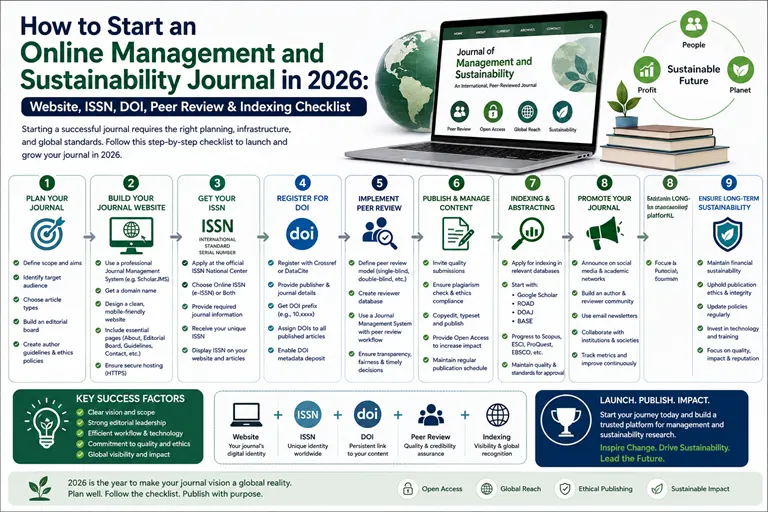
Whether you are an academic institution, a professional society, a university department, or an independent publisher, this guide outlines the essential steps to establish a professional Management and Sustainability Journal that attracts quality submissions and earns the confidence of researchers.
Why Launch a Management and Sustainability Journal?
Management research is evolving rapidly in response to global challenges such as climate change, digital transformation, responsible leadership, ESG reporting, circular economy initiatives, artificial intelligence, and sustainable business innovation.
A dedicated journal enables organizations to:
- Promote original scholarly research.
- Support interdisciplinary collaboration.
- Create a platform for emerging researchers.
- Encourage evidence-based management practices.
- Strengthen institutional academic reputation.
- Foster international research partnerships.
- Contribute to policy and business innovation.
With increasing interest in sustainability and responsible management, journals focusing on these themes have significant opportunities to establish long-term academic value.
Step 1: Define the Journal's Vision, Aim, and Scope
Every successful academic journal begins with a clearly defined mission.
Before developing the website or inviting submissions, determine:
Journal Vision
What long-term contribution will the journal make to management scholarship?
Aim
What type of research will the journal publish?
Scope
Clearly identify the subject areas, such as:
- Strategic Management
- Human Resource Management
- Marketing
- Finance
- Entrepreneurship
- Corporate Governance
- Sustainable Development
- ESG
- Green Business
- Supply Chain Management
- Innovation Management
- Organizational Behaviour
- Business Analytics
- Digital Transformation
- Circular Economy
- Public Administration
- Corporate Social Responsibility
A well-defined scope improves discoverability and attracts relevant authors.
Step 2: Build a Professional Journal Website
A journal website is far more than a digital brochure. It is the operational hub for submissions, peer review, editorial communication, publication, indexing, and reader access.
Your website should include:
- Home
- About the Journal
- Aims & Scope
- Editorial Board
- Ethics Policy
- Peer Review Policy
- Author Guidelines
- Publication Ethics
- Copyright Policy
- Open Access Policy
- APC Information (if applicable)
- Current Issue
- Archives
- Editorial Workflow
- Contact Page
- Online Submission System
A responsive, secure, and professionally designed website enhances credibility for authors and reviewers.
Why ScholarJMS?
Modern journals increasingly prefer ScholarJMS because it combines:
- Journal website management
- Online manuscript submission
- Editorial workflow
- Reviewer assignment
- Editorial decision tracking
- Production workflow
- Publication management
- Archive management
- DOI-ready article pages
- Mobile-friendly interface
Unlike traditional systems that often require extensive customization and technical maintenance, ScholarJMS offers an integrated publishing environment designed for contemporary academic journals.
Need Help Launching Your Journal?
Whether you are starting a new journal or modernizing an existing one, we can assist with:
- ScholarJMS journal website setup
- Complete editorial workflow configuration
- OJS migration
- ISSN consulting
- Journal launch planning
- Publishing best practices
WhatsApp: +91 82003 85143
Email: inquiry@ojscloud.com
Step 3: Build a Strong Editorial Board
Editorial credibility significantly influences author confidence.
Your editorial board should include experts from multiple institutions and, where possible, different countries.
Important positions include:
- Editor-in-Chief
- Managing Editor
- Associate Editors
- Editorial Board Members
- Technical Editor
- Language Editor
- Advisory Board
Choose individuals with relevant academic expertise, publication records, and editorial experience.
Step 4: Develop Clear Editorial Policies
Transparency is a hallmark of reputable scholarly publishing.
Your journal should publish policies covering:
- Editorial independence
- Peer review
- Publication ethics
- Conflict of interest
- Retraction policy
- Correction policy
- Data availability
- Research integrity
- AI-assisted writing disclosures
- Plagiarism screening
These policies reassure authors and support future indexing applications.
Step 5: Establish a Robust Peer Review Process
Peer review remains the foundation of academic quality.
Most management journals adopt a double-blind peer review model, in which neither authors nor reviewers know each other's identities.
A typical workflow includes:
- Initial editorial screening.
- Plagiarism check.
- Reviewer assignment.
- Reviewer evaluation.
- Editorial decision.
- Author revision.
- Final acceptance.
- Copyediting.
- Proofreading.
- Publication.
Efficient workflow management shortens turnaround time while maintaining quality.
Step 6: Obtain an ISSN
An International Standard Serial Number (ISSN) uniquely identifies your journal.
Although obtaining an ISSN is straightforward when requirements are met, many new publishers face delays because their websites are not adequately prepared.
Professional ISSN consulting can help ensure that:
- The website meets expected standards.
- Essential journal policies are in place.
- Required metadata is complete.
- Publication readiness is demonstrated.
OJSCloud provides ISSN consulting and journal readiness support for institutions and publishers planning new scholarly journals.
Step 7: Plan Crossref DOI Registration
Digital Object Identifiers (DOIs) improve the discoverability, citation, and permanence of scholarly articles.
Benefits include:
- Persistent article links.
- Improved citation tracking.
- Enhanced indexing compatibility.
- Greater academic visibility.
- Better researcher confidence.
Planning DOI implementation early avoids technical complications after publication.
GetDOI supports journals with:
- Crossref onboarding guidance.
- DOI workflow setup.
- Metadata preparation.
- DOI registration support.
- Best practices for article metadata.
Planning Crossref DOI Setup?
Our publishing specialists can guide your journal through:
- Crossref DOI planning
- Metadata preparation
- DOI registration workflow
- Publishing best practices
WhatsApp: +91 82003 85143
Email: inquiry@ojscloud.com
Step 8: Design a Professional Publication Workflow
An efficient editorial workflow improves both author satisfaction and editorial productivity.
A modern workflow should support:
- Online submissions
- Reviewer invitations
- Automated reminders
- Editorial decisions
- Version tracking
- Copyediting
- Proof approval
- DOI assignment
- Online publication
- Archive management
Automation reduces administrative workload while improving consistency.
Step 9: Publish High-Quality Initial Articles
Avoid launching an empty journal.
Prepare an inaugural issue featuring high-quality contributions from respected researchers.
Consider inviting:
- Review articles
- Original research
- Case studies
- Short communications
- Editorials
- Perspective papers
A strong first issue helps establish credibility.
Step 10: Prepare for Indexing
Indexing should be viewed as a long-term objective rather than an immediate milestone.
Ensure that your journal demonstrates:
- Consistent publication frequency.
- High editorial quality.
- Ethical publishing practices.
- Professional website structure.
- Complete metadata.
- DOI implementation.
- International editorial participation.
Meeting these standards strengthens future indexing applications.
Common Mistakes to Avoid
Many new journals encounter avoidable challenges.
Common mistakes include:
- Launching without a clear scope.
- Incomplete editorial policies.
- Weak editorial boards.
- Delayed peer review.
- Poor website usability.
- Missing DOI strategy.
- Inconsistent publication schedules.
- Inadequate metadata.
- Limited international representation.
- Neglecting long-term sustainability.
Avoiding these issues improves the journal's reputation from the outset.
Why Modern Journal Platforms Matter
While several journal management systems are available, publishers increasingly seek solutions that minimize technical complexity while supporting the complete publishing lifecycle.
Modern platforms should provide:
- Intuitive author interfaces.
- Efficient reviewer management.
- Editorial dashboards.
- Automated workflows.
- Responsive design.
- SEO-friendly article pages.
- DOI readiness.
- Secure cloud hosting.
- Analytics and reporting.
- Long-term scalability.
Selecting the right platform at the beginning reduces future migration challenges.
Building Long-Term Journal Success
Launching the journal is only the beginning.
Long-term success depends on:
- Maintaining publication schedules.
- Recruiting quality reviewers.
- Publishing rigorous research.
- Improving editorial efficiency.
- Expanding international collaborations.
- Promoting published articles.
- Monitoring journal performance.
- Continuously enhancing the author experience.
Academic reputation grows through consistency, transparency, and quality.
Frequently Asked Questions
How much time does it take to start an academic journal?
The timeline varies depending on planning, website development, editorial board formation, and policy preparation. Many journals spend several months completing these foundational steps before publishing their first issue.
Do I need an ISSN before publishing?
An ISSN is an important identifier for scholarly journals and is generally obtained as part of the journal's launch process once the publication meets the relevant requirements.
Why are Crossref DOIs important?
DOIs provide permanent identifiers for articles, improving discoverability, citation, and long-term accessibility.
Which platform is suitable for a new journal?
A platform should support manuscript submission, peer review, editorial workflow, publication management, and long-term scalability. The choice depends on the journal's needs, available technical resources, and publishing goals.
Can an existing OJS journal migrate to another platform?
Yes. Journals can migrate to modern publishing platforms while preserving archives, metadata, and editorial continuity, provided the migration is carefully planned.
Conclusion
Launching an online Management and Sustainability journal in 2026 requires more than a website. It demands a clear scholarly vision, robust editorial governance, transparent peer review, reliable publishing technology, and a long-term commitment to research quality.
By investing in professional infrastructure, ethical publishing practices, ISSN readiness, DOI planning, and efficient editorial workflows, new journals can establish a strong foundation for sustainable growth and academic credibility.
Whether you are a university, research institute, professional association, or independent publisher, thoughtful planning today can position your journal for long-term success in an increasingly competitive scholarly publishing landscape.
Ready to Launch or Upgrade Your Journal?
We provide end-to-end support for academic publishers, including:
- ScholarJMS for journal websites, manuscript submission, editorial workflow, and online publishing.
- OJSCloud for OJS hosting, migration, ISSN consulting, journal launch support, and publishing consultancy.
- GetDOI for Crossref DOI guidance, metadata preparation, and DOI workflow support.
- Scholar9 for transparent peer review and research trust initiatives.
Contact us today:
WhatsApp: +91 82003 85143
Email: inquiry@ojscloud.com
Let us help you build a professional, future-ready scholarly journal.