Sustainable Facility Management in Higher Education Institutions: A Practical Research Perspective
Sustainable Facility Management in Higher Education Institutions: A Practical Research Perspective
Introduction
Higher education institutions are no longer evaluated solely on the quality of teaching and research. Universities and colleges are increasingly expected to operate as responsible organizations that promote environmental stewardship, efficient resource utilization, social responsibility, and long-term institutional sustainability. As campuses continue to expand and incorporate advanced technologies, the management of physical infrastructure has become a strategic function rather than a purely operational responsibility.
Facility management now plays a central role in achieving institutional sustainability. From energy-efficient buildings and smart classrooms to water conservation, waste management, campus safety, and digital infrastructure, sustainable facility management supports the long-term objectives of higher education institutions while enhancing the experience of students, faculty, researchers, and administrative staff.
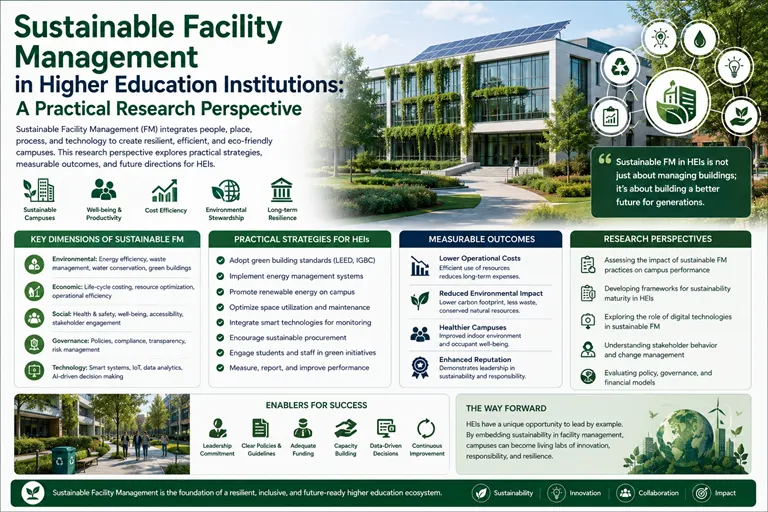
In 2026, universities worldwide are investing in green campuses, intelligent building systems, renewable energy, and environmentally responsible operational practices. These initiatives not only reduce operational costs but also contribute to institutional resilience, environmental protection, and global sustainability goals.
This article explores the concept of sustainable facility management, its importance in higher education institutions, practical implementation strategies, emerging trends, challenges, and future research opportunities.
Understanding Sustainable Facility Management
Facility management involves planning, operating, maintaining, and continuously improving an organization's physical assets and support services.
Sustainable facility management extends this responsibility by integrating:
- Environmental sustainability
- Economic efficiency
- Social responsibility
- Operational excellence
- Long-term infrastructure planning
Rather than focusing solely on building maintenance, sustainable facility management seeks to optimize the performance of the entire campus ecosystem.
Why Sustainable Facility Management Matters in Higher Education
Universities manage extensive physical infrastructure, including:
- Academic buildings
- Research laboratories
- Libraries
- Student residences
- Administrative offices
- Sports facilities
- Healthcare centers
- Transportation systems
- Green spaces
Operating these facilities requires significant financial and natural resources.
Sustainable facility management helps institutions:
- Reduce operating costs
- Improve energy efficiency
- Minimize environmental impact
- Enhance campus safety
- Increase infrastructure longevity
- Support institutional sustainability goals
- Improve stakeholder satisfaction
As environmental regulations and sustainability expectations continue to evolve, facility management has become a strategic priority for educational institutions.
Core Components of Sustainable Facility Management
Energy Management
Energy consumption represents one of the largest operational expenses for universities.
Effective energy management includes:
- LED lighting systems
- Smart HVAC control
- Building automation
- Renewable energy integration
- Energy monitoring
- Occupancy sensors
Reducing energy consumption lowers operating costs while decreasing greenhouse gas emissions.
Water Conservation
Water management has become increasingly important in sustainable campuses.
Common initiatives include:
- Rainwater harvesting
- Smart irrigation
- Water-efficient fixtures
- Leak detection systems
- Wastewater recycling
Responsible water management contributes to environmental conservation and financial savings.
Waste Management
Universities generate substantial quantities of paper, plastic, food waste, laboratory waste, and electronic waste.
Sustainable waste management strategies include:
- Waste segregation
- Recycling programs
- Composting
- Digital documentation
- Responsible e-waste disposal
These initiatives support circular economy principles and reduce landfill dependence.
Green Buildings
Modern campuses increasingly adopt sustainable building practices.
Characteristics of green buildings include:
- Energy-efficient design
- Natural ventilation
- Daylight optimization
- Sustainable construction materials
- Indoor air quality improvement
- Green roofing systems
Green buildings enhance occupant comfort while reducing long-term operating costs.
Sustainable Procurement
Facility management extends beyond infrastructure to purchasing decisions.
Institutions increasingly prioritize:
- Environmentally responsible suppliers
- Recycled materials
- Energy-efficient equipment
- Sustainable office products
- Local sourcing where appropriate
Sustainable procurement strengthens institutional environmental responsibility.
Smart Campus Technologies
Digital transformation is reshaping facility management.
Universities increasingly deploy:
- Internet of Things (IoT) sensors
- Smart building management systems
- Digital twins
- Predictive maintenance
- AI-driven energy optimization
- Occupancy analytics
- Automated security systems
These technologies enable real-time monitoring and improve operational decision-making.
Benefits of Sustainable Facility Management
Financial Efficiency
Resource optimization reduces long-term operating costs through improved energy efficiency, preventive maintenance, and better asset utilization.
Environmental Sustainability
Reducing resource consumption supports institutional climate goals and environmental responsibility.
Improved Learning Environment
Comfortable classrooms, reliable infrastructure, and healthy indoor environments contribute to better learning experiences for students and faculty.
Institutional Reputation
Universities recognized for sustainability often attract environmentally conscious students, researchers, faculty members, and funding opportunities.
Risk Management
Preventive maintenance and resilient infrastructure reduce operational disruptions and improve campus safety.
Challenges in Implementation
Despite its advantages, sustainable facility management presents several challenges.
Financial Constraints
Initial investments in sustainable technologies may require substantial capital.
However, many initiatives generate long-term operational savings.
Aging Infrastructure
Older campus buildings may require significant renovation before sustainability measures can be effectively implemented.
Organizational Resistance
Successful implementation requires collaboration among administrators, facility managers, faculty, students, and external stakeholders.
Resistance to organizational change may slow progress.
Skills and Expertise
Facility managers increasingly require knowledge of:
- Sustainability
- Data analytics
- Smart technologies
- Energy systems
- Environmental regulations
- Digital infrastructure
Continuous professional development is essential.
Data Management
Smart campuses generate large volumes of operational data.
Institutions must establish systems for data collection, analysis, cybersecurity, and evidence-based decision-making.
Role of Leadership
Institutional leadership strongly influences sustainability initiatives.
Effective leaders:
- Establish sustainability goals.
- Allocate financial resources.
- Encourage stakeholder participation.
- Promote environmental awareness.
- Support innovation.
- Integrate sustainability into institutional strategy.
Leadership commitment transforms sustainability from isolated projects into long-term organizational culture.
Sustainable Facility Management and ESG
Environmental, Social, and Governance (ESG) principles increasingly influence higher education institutions.
Facility management contributes directly to ESG objectives through:
Environmental
- Energy conservation
- Carbon reduction
- Waste management
- Water conservation
Social
- Healthy learning environments
- Accessibility
- Campus safety
- Employee well-being
Governance
- Transparent reporting
- Regulatory compliance
- Ethical procurement
- Strategic planning
Integrating ESG principles strengthens institutional accountability and sustainability performance.
Emerging Trends in 2026
Several developments continue shaping sustainable facility management.
These include:
- Net-zero campus initiatives
- AI-assisted building management
- Digital twins
- Renewable energy microgrids
- Carbon accounting
- Smart mobility systems
- Circular campus models
- Climate resilience planning
- Sustainable procurement analytics
- ESG reporting in higher education
These innovations continue improving operational efficiency and environmental performance.
Future Research Directions
Researchers continue exploring several important topics.
Potential areas include:
- AI in facility management
- Smart campus technologies
- Green building performance
- ESG implementation in universities
- Sustainable procurement
- Climate resilience
- Circular economy in campuses
- Renewable energy integration
- Student engagement in sustainability
- Data-driven campus management
These research opportunities contribute to both management scholarship and institutional sustainability.
Implications for Universities
Universities should recognize facility management as a strategic management function rather than simply an operational service.
Long-term success depends on integrating sustainability into:
- Institutional planning
- Infrastructure investment
- Financial management
- Campus operations
- Environmental governance
- Digital transformation
By adopting sustainable facility management practices, higher education institutions can improve operational efficiency while contributing to broader environmental and societal goals.
Frequently Asked Questions
What is sustainable facility management?
Sustainable facility management involves planning, operating, and maintaining buildings and infrastructure in ways that improve environmental performance, operational efficiency, and long-term sustainability.
Why is facility management important for universities?
Effective facility management supports teaching, research, campus safety, environmental responsibility, financial efficiency, and institutional resilience.
What technologies support sustainable campuses?
Common technologies include IoT sensors, smart building systems, AI-powered energy management, predictive maintenance, digital twins, and occupancy analytics.
How does facility management contribute to ESG?
Facility management supports environmental sustainability, social well-being, governance practices, energy efficiency, resource conservation, and regulatory compliance.
What research opportunities exist in sustainable facility management?
Researchers can investigate smart campuses, renewable energy, AI, green buildings, ESG implementation, climate resilience, sustainable procurement, and digital transformation.
Conclusion
Sustainable facility management has become an essential component of higher education strategy. As universities continue expanding their physical infrastructure while responding to environmental, financial, and technological challenges, effective facility management supports long-term institutional resilience and operational excellence.
By integrating energy efficiency, smart technologies, sustainable procurement, environmental stewardship, and ESG principles into campus operations, higher education institutions can create healthier learning environments while reducing costs and supporting global sustainability objectives.
The International Journal of Management and Sustainability Practices (IJMSP) encourages researchers, facility managers, administrators, and policy makers to contribute original research exploring sustainable campus management, green infrastructure, environmental governance, smart facilities, and organizational sustainability. Interdisciplinary research in these areas will continue to guide the development of future-ready educational institutions.
7. Recommended Internal Links
- Home
- About the Journal
- Aims & Scope
- Editorial Board
- Author Guidelines
- Publication Ethics
- Current Issue
- Archives
- Submit Manuscript
- Contact Us
- Blog: Sustainable Management Practices: Why Businesses Need Responsible Leadership in 2026
- Blog: AI in Management Education: Opportunities, Risks, and Future Research Directions
- Blog: Work-Life Integration in the Hybrid Workplace: Challenges for Women Professionals in IT