Sustainable Management Practices: Why Businesses Need Responsible Leadership in 2026
Sustainable Management Practices: Why Businesses Need Responsible Leadership in 2026
Introduction
The global business landscape is undergoing one of its most significant transformations in recent decades. Organizations are no longer evaluated solely on financial performance. Investors, employees, regulators, customers, and society increasingly expect businesses to demonstrate environmental responsibility, ethical governance, social accountability, and transparent leadership.
In 2026, sustainable management practices have become a strategic necessity rather than an optional corporate initiative. Organizations that integrate sustainability into decision-making are generally better positioned to manage risks, attract talent, strengthen stakeholder confidence, and create long-term value.
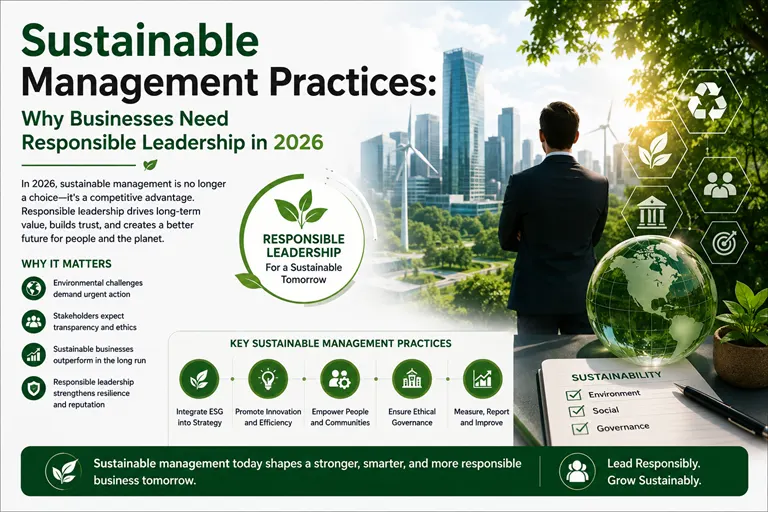
Responsible leadership plays a central role in this transformation. Modern leaders are expected to balance profitability with social responsibility while fostering innovation, resilience, and ethical decision-making across every level of the organization.
This article explores the principles of sustainable management, the characteristics of responsible leadership, emerging trends shaping organizations in 2026, implementation strategies, common challenges, and future research opportunities.
Understanding Sustainable Management Practices
Sustainable management refers to the process of managing organizations in a manner that simultaneously supports:
- Economic growth
- Environmental protection
- Social well-being
- Ethical governance
- Long-term organizational resilience
Unlike traditional management models that emphasize short-term financial performance, sustainable management considers the broader and longer-term impact of business decisions on multiple stakeholders.
These stakeholders include:
- Employees
- Customers
- Investors
- Communities
- Governments
- Supply chain partners
- Future generations
Sustainability is therefore not a separate business function. Instead, it becomes an integrated management philosophy influencing strategy, operations, human resources, innovation, finance, and corporate governance.
Why Sustainable Management Matters More Than Ever in 2026
Several global developments are accelerating the need for sustainable leadership.
Rising ESG Expectations
Environmental, Social, and Governance (ESG) considerations increasingly influence investment decisions, organizational reputation, and corporate reporting.
Organizations that proactively address ESG issues often experience improved investor confidence and stronger stakeholder relationships.
Climate Change and Environmental Responsibility
Businesses face growing expectations to reduce:
- Carbon emissions
- Waste generation
- Resource consumption
- Environmental pollution
Leaders must integrate environmental stewardship into operational and strategic planning.
Workforce Expectations
Today's workforce increasingly seeks employers whose values align with their own.
Employees often value:
- Ethical workplaces
- Diversity and inclusion
- Mental well-being
- Purpose-driven work
- Flexible work arrangements
Responsible leadership contributes significantly to employee engagement and retention.
Digital Transformation
Artificial intelligence, automation, and data analytics offer opportunities to improve operational efficiency while supporting sustainability objectives.
However, responsible implementation requires ethical governance, transparency, and accountability.
What Is Responsible Leadership?
Responsible leadership extends beyond managing organizational performance.
It involves leading with integrity while balancing the interests of multiple stakeholders.
Responsible leaders consider:
- Ethical implications
- Social responsibility
- Environmental sustainability
- Long-term organizational health
- Employee development
- Community impact
Rather than focusing exclusively on quarterly financial results, responsible leaders prioritize sustainable value creation.
Core Principles of Responsible Leadership
Ethical Decision-Making
Ethical leaders establish trust by making fair, transparent, and accountable decisions.
Integrity forms the foundation of organizational credibility.
Stakeholder Orientation
Modern leadership requires balancing the needs of:
- Shareholders
- Employees
- Customers
- Suppliers
- Communities
- Regulators
Successful organizations recognize that long-term profitability depends on maintaining healthy stakeholder relationships.
Long-Term Strategic Thinking
Responsible leaders prioritize sustainable growth over short-term gains.
Long-term planning includes:
- Risk management
- Innovation
- Talent development
- Resource conservation
- Continuous improvement
Transparency
Open communication strengthens organizational trust.
Transparency includes:
- Honest reporting
- Clear governance
- Responsible disclosure
- Ethical financial practices
Inclusivity
Inclusive leadership encourages diverse perspectives, equal opportunities, and collaborative decision-making.
Diverse organizations often demonstrate stronger innovation capabilities and improved problem-solving.
Characteristics of Sustainable Organizations
Organizations committed to sustainability typically exhibit several common characteristics.
Clear Sustainability Vision
Leadership defines measurable sustainability objectives aligned with organizational strategy.
Responsible Corporate Governance
Boards and executive teams oversee sustainability performance alongside financial outcomes.
Employee Engagement
Employees actively participate in sustainability initiatives through innovation, volunteering, resource conservation, and continuous improvement.
Data-Driven Decision-Making
Organizations increasingly rely on analytics to monitor sustainability indicators, operational performance, and strategic progress.
Continuous Innovation
Sustainable organizations encourage innovation that simultaneously improves efficiency and societal impact.
Business Benefits of Sustainable Management
Implementing sustainable management practices offers numerous organizational advantages.
Enhanced Corporate Reputation
Ethical organizations tend to build stronger public trust.
Positive reputations contribute to customer loyalty and stakeholder confidence.
Improved Risk Management
Responsible leadership helps organizations anticipate and manage:
- Regulatory changes
- Environmental risks
- Supply chain disruptions
- Reputational risks
- Governance challenges
Better Talent Attraction
Purpose-driven organizations often attract highly skilled professionals seeking meaningful careers.
Increased Operational Efficiency
Sustainability initiatives frequently improve:
- Energy efficiency
- Resource utilization
- Waste reduction
- Cost optimization
Stronger Innovation
Organizations focused on sustainability often develop innovative products, services, and business models that address emerging societal needs.
The Relationship Between Sustainability and Corporate Strategy
Sustainability should not function as an isolated department.
Instead, it should be embedded into strategic planning.
This includes integrating sustainability within:
- Business objectives
- Investment decisions
- Product development
- Marketing
- Supply chain management
- Human resource policies
- Performance evaluation
Organizations that integrate sustainability into corporate strategy often demonstrate greater resilience during economic uncertainty.
Leadership Competencies Required in 2026
Responsible leaders increasingly require a diverse set of competencies.
These include:
Strategic Thinking
Understanding long-term market trends and organizational resilience.
Systems Thinking
Recognizing how organizational decisions affect interconnected stakeholders.
Emotional Intelligence
Building trust, empathy, and collaboration across teams.
Digital Competence
Leveraging emerging technologies responsibly.
Ethical Judgment
Making balanced decisions under uncertainty.
Sustainability Literacy
Understanding environmental, social, and governance principles.
Emerging Trends in Sustainable Management
Several trends are expected to shape management practices throughout 2026.
Artificial Intelligence for Sustainability
AI assists organizations in optimizing energy consumption, forecasting demand, improving logistics, and enhancing decision-making.
Responsible governance remains essential to ensure ethical AI implementation.
Circular Economy
Organizations increasingly adopt circular business models emphasizing:
- Recycling
- Product reuse
- Resource recovery
- Waste minimization
Green Supply Chains
Businesses collaborate with suppliers committed to sustainable production practices.
Supply chain transparency has become increasingly important.
Employee Well-being
Organizations recognize employee health and psychological safety as strategic priorities.
Healthy workplaces contribute to productivity and organizational resilience.
Responsible Innovation
Innovation is increasingly evaluated not only for profitability but also for societal and environmental impact.
Challenges in Implementing Sustainable Management
Despite its benefits, organizations face several implementation challenges.
Resistance to Change
Employees and managers may initially resist new sustainability initiatives.
Effective communication and leadership support are essential.
Short-Term Financial Pressures
Organizations sometimes prioritize immediate profitability over long-term investments.
Responsible leadership balances both perspectives.
Measuring Sustainability Performance
Quantifying sustainability outcomes remains complex.
Organizations increasingly rely on integrated performance indicators and ESG reporting frameworks.
Regulatory Complexity
Global organizations must comply with diverse environmental and governance regulations across multiple jurisdictions.
Skills Gap
Leaders require continuous education in sustainability, digital technologies, governance, and stakeholder management.
Building a Sustainable Leadership Culture
Creating a sustainable organization begins with organizational culture.
Key strategies include:
- Developing ethical leadership programs
- Encouraging transparent communication
- Rewarding responsible behavior
- Supporting diversity and inclusion
- Investing in employee learning
- Integrating sustainability into performance evaluations
- Encouraging innovation
- Promoting cross-functional collaboration
Leadership culture influences every organizational decision.
Future Research Directions
Researchers continue to investigate several emerging areas within sustainable management.
Potential research topics include:
- AI governance and responsible leadership
- ESG reporting effectiveness
- Sustainable entrepreneurship
- Green innovation strategies
- Climate leadership
- Sustainable organizational resilience
- Circular economy adoption
- Employee engagement in sustainability initiatives
- Digital transformation and sustainability
- Leadership development for future organizations
These research areas offer valuable opportunities for interdisciplinary collaboration.
Implications for Researchers and Practitioners
For researchers, sustainable management represents a rapidly evolving field with significant theoretical and practical relevance.
For practitioners, responsible leadership provides a pathway toward stronger organizational resilience, stakeholder trust, and long-term competitiveness.
Business schools, policy makers, industry leaders, and academic institutions all play essential roles in advancing sustainable management practices.
Frequently Asked Questions
What are sustainable management practices?
Sustainable management practices are organizational strategies that balance economic performance with environmental responsibility, social well-being, and ethical governance.
Why is responsible leadership important?
Responsible leadership supports ethical decision-making, stakeholder trust, long-term organizational success, and sustainable business growth.
What is the relationship between ESG and sustainable management?
ESG provides measurable environmental, social, and governance indicators that help organizations evaluate sustainability performance.
Can small businesses implement sustainable management?
Yes. Organizations of all sizes can adopt sustainable practices by improving resource efficiency, promoting ethical governance, engaging employees, and considering long-term stakeholder value.
What skills should future managers develop?
Future managers should strengthen strategic thinking, sustainability literacy, ethical decision-making, emotional intelligence, digital competence, and stakeholder engagement.
Conclusion
Sustainable management practices are reshaping how organizations define success. In 2026, responsible leadership extends beyond profitability to encompass environmental stewardship, ethical governance, employee well-being, and long-term stakeholder value.
Organizations that embed sustainability into strategy, culture, and decision-making are better equipped to navigate uncertainty, foster innovation, and build lasting resilience. At the same time, researchers have an important opportunity to expand the evidence base by exploring emerging topics such as AI governance, ESG performance, circular economy models, and sustainable organizational transformation.
The International Journal of Management and Sustainability Practices (IJMSP) welcomes high-quality research that advances understanding of responsible leadership, sustainable business models, organizational innovation, corporate governance, and related interdisciplinary themes. Through rigorous scholarship and practical insights, the journal aims to contribute to the evolving dialogue on sustainable management in both academic and professional settings.